
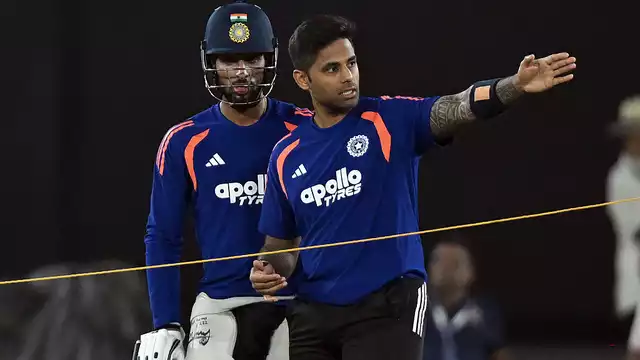
Suryakumar Yadav Backs Tilak Varma Amid Scrutiny: "No Concerns Whatsoever"
The conversation around India's No. 3 position has grown louder with each passing match, but Suryakumar Yadav is having none of it. Speaking on the eve of India's crucial encounter against South Africa, the India captain threw his unequivocal support behind Tilak Varma, shutting down questions about potential changes to his batting order with characteristic calm confidence.
Tilak's World Cup numbers tell a story that has made even the most patient India fans shift in their seats. Four innings, four scores between 25 and 31—not exactly the explosive introduction expected from someone occupying cricket's most coveted batting position in T20 internationals. The strike rate numbers paint an even starker picture. Apart from a blistering start against the USA where he struck at over 150, Tilak has operated in the 104-115 range—respectable but hardly theインパクト (impact) expected from India's designated anchor in the middle overs.
The timing of his dismissals has perhaps raised the most eyebrows. On multiple occasions, Tilak has departed precisely when the innings demanded acceleration, leaving India scrambling to rebuild rather than pressing forward. For a player of his pedigree and with the weight of expectations that come with wearing India's No. 3 jersey, these moments have amplified scrutiny.
Yet Suryakumar's backing remained unwavering when pressed on the matter. "Not really," he responded when asked if he harbored concerns about Tilak's modest returns. The captain proceeded to outline a role that extends far beyond simply launching attacks from ball one, revealing the nuanced thinking behind India's batting construction at this tournament.
The Calculated Approach Behind India's No. 3 Strategy
Suryakumar pulled back the curtain on the specific instructions given to Tilak, painting a picture of a structured yet flexible approach tailored to different match situations. "I mean, I have told him, the team management has told him that he has to bat that way," the India skipper explained. "If one wicket is down, then he can definitely go and have his own game in the powerplay. But as soon as two wickets are down, then he has to take a little bit of a backseat, build a partnership again, get to the 10th over and then we have enough firepower to continue and take on the bowling."
This philosophy represents a deliberate departure from the all-guns-bl approach that some might expect from India's ultra-aggressive batting lineup. Instead, Suryakumar sees Tilak as a stabilizer who creates the foundation upon which India's power hitters can operate in the death overs. The strategy hinges on trust—trust that Tilak will do his job in the middle phase, and trust that the likes of Hardik Pandya, Shivam Dube, and the captain himself will provide the late-innings explosion.
"Yeah, definitely I am sure he must not be happy with how he is batting right now," Suryakumar admitted, acknowledging Tilak's own frustration with his output. "And he has practised a lot as well in the last two or three practice sessions. But I don't have any concerns regarding him. He has been delivering for India at No. 3 really well and I am very confident that he will do it better."
The captain's confidence extends beyond mere rhetoric. He pointed to Tilak's broader track record in the role, suggesting that a small sample size of tournament cricket shouldn't overwrite months of consistent performance in bilateral series.
Dismissing the Samson Suggestion With a Smile
When the question of replacing Tilak with the in-form Sanju Samson arose, Suryakumar's response carried a hint of amusement at the premise. "You mean I should make him play for Tilak...?" he smiled, before shutting down the speculation with a simple yet effective explanation of why the current combination works.
"It's going well in the Powerplay. We're making 40-50 runs. That's normal cricket. Now we've played so well in bilaterals. It happens—we have expectations, we also have expectations from ourselves."
The captain acknowledged the pressure that comes with India's fanbase and media environment, where any slight deviation from dominant performances triggers immediate calls for change. Yet he maintained that the wickets they've encountered have presented unique challenges that require adaptation rather than wholesale personnel changes.
"Expectations to make 220, 240, 250. But the wickets are a little different here. The four wickets we have played on so far were a little different and challenging. Off-spinners were not bowling earlier but are now. So we have started preparation for that and hopefully we will tackle it as we start our Super 8 journey."
Standing Behind Abhishek Sharma: The Ultimate Show of Faith
Perhaps the most striking moment came when Suryakumar addressed the situation surrounding Abhishek Sharma, the world's top-ranked T20I batter who has yet to score a run in this World Cup. Rather than express concern, the captain turned the narrative on its head with a memorable defense of his struggling teammate.
"About Abhishek's form, I worry for the people who are worried about Abhishek's form. Why are they so worried about Abhishek's form? But I think about those teams who are going to play against him—that he has not yet scored a run. You know the rest of the answers."
The subtext was clear: Abhishek's inevitable breakthrough will be all the more devastating for opponents because of his current frustrations. Suryakumar drew on their experiences from last year, when Abhishek repeatedly delivered match-winning performances for India.
"It happens, it's a team sport, it keeps going on. Now the team has a requirement that the boy should play with his identity. So he is trying to play. If it happens, then it's fine; if it doesn't, then we are there to cover. Last year he covered for us, now we will cover for him."
This approach exemplifies the environment Suryakumar has cultivated within the India camp—one where temporary slumps are weathered collectively rather than used as justification for panic-driven changes.
India's Batting Philosophy: Smart Explosivity Over Reckless Aggression
The India skipper also offered insight into the team's broader batting philosophy, distinguishing their approach from a pure "hit from ball one" mentality that some T20 teams adopt. "We don't have to be a team that keeps hitting and hitting," he stated. "We are trying to explode from the start. Everyone knows the template. Sometimes we can get into a situation where we lose two wickets quickly, or three wickets quickly. So we have to be a little smart as a team to bat well between overs 7 to 15."
Suryakumar described the ideal scenario as one where India builds a solid foundation through the middle overs, positioning themselves to unleash their firepower in the final five overs. "Once the base is strong, we can score around 60 or 70 runs in the last five overs. So far, those situations have come."
The captain acknowledged that T20 cricket invariably presents challenging scenarios where early wickets force adaptation. In those moments, his philosophy calls for pragmatism over aggression. "But sometimes such tricky situations come in T20 cricket where you're two down, three down. So in the middle overs, you have to respect the game and keep your main game to the side. The team has to play according to the requirements."
Flexibility: India's Secret Weapon
Suryakumar concluded with a reinforcement of what has become a cornerstone of India's T20 approach: flexibility throughout the batting order. "Except the openers, from No. 3 to 7 or 3 to 8, everyone has to be very flexible and that has been the message in the group," he revealed.
He provided a specific example of how this flexibility might manifest during matches. "If there is no wicket down till eight or nine overs, there might be a point where you might see Shivam Dube walking in or even a Hardik Pandya walking in, if there is a proper match-up. So everyone has to be very flexible, even I am flexible. I have said the same thing to everyone. So if we get into that situation, we will definitely take that call."
This willingness to reshape the batting order on the fly, based on matchups and game state rather than rigid positional thinking, represents a significant tactical advantage for India. It keeps opponents guessing and maximizes the impact of their deep batting resources.
As India prepare to enter the Super 8 stage, Surya Kumar's words paint the picture of a confident, adaptable unit that trusts its processes over individual performances. Whether that philosophy translates to tournament glory will become clear in the coming weeks, but one thing is certain: the India captain has full belief in his team and their approach.